Pastoral Letter: 3rd Quarter 2024
October 3, 2024
Pastoral Letter: 1st Quarter 2025
March 20, 2025Pastoral Letter: 3rd Quarter 2024
October 3, 2024Pastoral Letter: 1st Quarter 2025
March 20, 2025
AFM Family,
AFM Family,
We are standing at the end of another year – looking back with gratitude for all God has done for us. 2024 will be remembered as a year of dynamic progression and forward motion in the AFM of SA. During the AFM National Conference in September, we were reminded of our Pentecostal roots and the Holy Spirit Fire that sets and keeps us ablaze – so that we can go and impact our world as Holy Spirit-filled followers of Christ. The world and South Africa need the presence of God.
For the last Pastoral Letter, I have requested my fellow National Office Bearers to share their thoughts on the following three topics: (i) Reflecting on 2024 & Looking Ahead to 2025, (ii) A Pastoral Reflection: Balancing Ministry and Family Life and (iii) Financial Stewardship: Insights & Tips. In the closing remarks, I share a message of hope and encouragement – setting the spiritual tone as we enter the new year. I trust that you will find the messages helpful and practical.
1. REFLECTING ON 2024 & LOOKING AHEAD TO 2025
Dr Henri Weideman:
As we look back on 2024, there is so much to be thankful for and to celebrate as a church family. This year marked the start of the AFM Legacy Leadership Program, a significant step in equipping leaders for the future. We also saw the Welfare Department stabilize, ensuring that we can continue to support those in need more effectively. Our Theological Education has made great strides, strengthening the foundation for sound training and deeper spiritual growth for all members who experience the call of God to ministry. We have also laid a solid foundation to accelerate Church Growth, preparing us to expand our reach and impact in the years to come.
Through it all, we are grateful for God’s guidance and the dedication of everyone who worked together to make these achievements possible. Truly, 2024 has been a year of progress and promise! We look forward to new heights and achievements in 2025.


Pastor Barend Petersen:
The momentum of the AFM Church Planting and Revitalizing Strategy has seriously gained momentum in 2024. Through comprehensive training modules and practical guidance, the leaders of our church are equipped with tools and strategies to plant new churches and revitalize congregations. Through this training, we prayerfully stir up the gift of God, according to 2 Timothy 1: 6-7 to equip and empower our pastors and leaders to grow our AFM assemblies for a bigger impact and establish the Kingdom of God. The momentum generated by the success of the training program has sparked a renewed commitment to proactive evangelism and church-planting efforts, positioning the AFM for sustained growth and relevance in an ever-changing landscape of faith and society. In a world that is more divided than ever before, a united AFM is divinely charged to be the salt of the earth and the light of the world.
The AFM Campus Ministries are active at ten (10) Universities and their activities include leadership workshops, evangelism and revival outreaches, exam prayers, Sunday services and weekly prayer meetings. The outcome of research by the National Youth Department into the reasons why we lose many of our AFM children is being considered by the National Office Bearers.
Pastor Selby Khumalo:
As we reflect on the past year and look ahead to 2025, we have been actively engaged in developing three essential strategic documents that are intended to enhance the AFM’s operational efficiency, mission alignment and approach moving forward:
1. AFM Communication Framework Strategy
2. AFM National Conference Coordination Strategy
3. AFM Pastoral Wellness Strategy
These outlines are designed for impactful innovation and tangible progress within our Church. Further, at the AFM National Office, we are committed to continuous data integrity standards and implementing thorough verification processes for our assemblies and pastors - which are crucial for fostering trust, ensuring accuracy, and maintaining accountability.
As we enter the new season, we remain steadfast in our dedication to the core values of Pentecostalism. We draw strength from the assurance that "God causes all things to work together for our good" (Romans 8:28). With optimism and resolve, we anticipate our efforts' positive impacts on our assemblies, families and communities. Together, we will navigate the path ahead with faith and purpose.
Pastor Rudi Coertzen:
It is such a privilege to be a member of the AFM of SA. This church personifies the calling that God has placed on us in its actions and ministry. This year again, we saw not just numerical growth, but also personal growth in our own but also our members' lives. Wherever I travelled I saw the difference our assemblies make in their communities.
Some by reaching out to the vulnerable and older people, and others by feeding the needy daily. Our pastors and members, as servants of God, implement our vision of enlarging our impact by preaching and sharing the Good News and keeping the fire ablaze. May God give us all the courage to keep the good work going.
2. PASTORAL REFLECTION: BALANCING MINISTRY & LIFE
Dr Henri Weideman:
Balancing ministry work and family life can be tough, but it is essential for pastors and their families to stay healthy and effective. Start by setting clear boundaries between work and home and scheduling non-negotiable family time. Prioritize your spouse and kids by being present with them, not just physically but emotionally too. Communicate openly with your family about your ministry schedule and involve them in decisions regarding your schedule where possible. Delegate tasks in the church to trusted leaders so you are not carrying everything alone. Most importantly, remember that God values your family just as much as your calling - both are part of His plan for your life.
From quite early in my ministry, me and my wife scheduled one night every week as a “date night.” We go somewhere to have a coffee, or just spend some time together - without talking about “work”. Over the years we sometimes had to move the night to a different one, if something urgent had to be attended to, but we kept on doing it.
Another thing that I find helpful is to change from “work clothes” into “home clothes” when I get home, it helps to psychologically make the transition from work to being at home with my family. Whilst our daughter was still at home, I regularly scheduled an “appointment” with her during which we would talk about whatever shé wanted to talk about. This went a long way in ensuring that to this day we still have a good and open relationship.
Pastor Barend Petersen:
We all have a public (front stage) and private life (backstage) life. The front stage is the public world of ministry. It’s where we’re noticed, where the spotlight is on us, where people applaud and affirm us. It’s where we inspire others and lead with skill and divine authority. The front stage is all about doing. We also have a private backstage life - and the two are connected. If we neglect the backstage life including our family, our prayer life, our personal walk with God or managing our personal affairs and finances - the front stage will eventually fall apart.
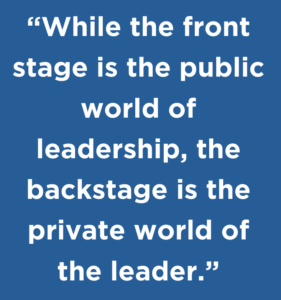
While the front stage is the public world of leadership, the backstage is the private world of the leader. The audience isn’t allowed there as the backstage has no spotlight and no glory. What happens backstage facilitates and empowers what takes place on the front stage. Backstage is all about being. Man shall not live by bread alone but by every word from the mouth of God.
Pastor Selby Khumalo:
In our roles as spiritual leaders, we are deeply rooted in family values, which we cherish and uphold. We recognise that effective leadership is about guiding others and nurturing deeper connections within our families. To this end, we prioritise prayer and scripture study, understanding that spiritual growth is essential to our collective spiritual journey. Equally, we emphasise the importance of dedicating quality time to our families, as a balanced home environment directly contributes to overall spiritual well-being.
Pastor Rudi Coertzen:
This topic is easily neglected by many of our leaders. Many think that you rest only when you are tired and many times we only rest after a scare of burn-out - but that is not how God planned it for us. His dream is that we should minister out of a space of rest. We rest before we commence our task because then we will be fresh and be able to minister on a much higher level. When we are rested, we are usually easier to live with. Our family, who sometimes take the brunt of our hastiness, will find a much better-behaved person at home and the office. As we move into a rest season, remember that life is not just hard work, but we need time to reflect, think and plan to be the best version of ourselves. Enjoy this time of rest!

3. FINANCIAL STEWARDSHIP: INSIGHTS & TIPS
Dr Henri Weideman:
Managing personal finances responsibly is important for every person to avoid unnecessary stress and set a good example for others. Start by creating a simple budget that tracks your income and expenses, making sure to live within your means. Avoid unnecessary debt, and if you have loans, work on paying them off steadily. Save a portion of your income regularly, even if it is a small amount, to prepare for emergencies and future needs. Be wise with your spending—distinguish between needs and wants, and prioritize essentials like housing, food, and giving. Lastly, seek advice when needed, whether from a financial advisor or trusted mentor, to ensure your finances stay on track.
Since my first month as a pastor, I have kept a monthly budget in a black A4 (counter) book. It includes my tithe, as well as income and expenses. By keeping a budget, I ensure I do not spend more than I receive. I also ensure that I save something to make provision for retirement. Every one of us can “sacrifice” something and use that money towards a retirement annuity or something similar. In our case, we never had (and still do not have) DSTV.
Pastor Barend Petersen:
So often we define ourselves by what we possess, and the advertising industry regularly reminds us of the things we do not have, and that we should aspire to have. Balancing our needs and our wants within the context of our disposable income is a constant battle and requires us to exercise prudence and stewardship of our personal financial situation and to live within our means. I’ve learned, for example, that early investment in assets with growth potential, for example in property, and retirement funding are far more valuable in the long run than regularly replacing cars whose value only reduces with time.

Pastor Selby Khumalo:
We are committed to responsible stewardship of the resources entrusted to us. Sound financial planning and the establishment of savings for unforeseen circumstances are not merely prudent practices; they are essential components of our well-being. Adopting a forward-thinking approach to our financial management enhances our resilience and capacity to serve our families and congregations effectively.

Pastor Rudi Coertzen:
The best way to manage your finances is to send your money in the right places. How do we do that? By working according to a budget. If you don’t have a budget, you will find that the end of your money comes before the next paycheck. It will also be difficult to report what you did with your money. A budget is a guideline to spend your money on the things and services that are important to you and your family. Without a budget, we tend to buy things that we don’t need and usually end up in debt. Your budget will help you to plan ahead.
Every household should have a safety net to the value of at least three months of expenses in an accessible account. That way no crisis will be a crisis, because you have the means to overcome and manage financial stumbling blocks. The feel-good factor of having a nest egg will help you to live a life without financial stress.
Conclusion
As we step into the new year, let us embrace it with hope and faith that God has greater things ahead for us as pastors, families, and church members. I believe that 2025 is not a year to settle for just maintaining what we have already achieved or sticking to what feels comfortable. Instead, it is a season to break new ground - spiritually, emotionally, in our personal lives and in our ministries.
I believe God is calling us to dream bigger, trust Him more deeply, and step into areas we have never explored before. Challenges may come but remember that His strength is made perfect in our weakness. Together, let us press forward with courage, knowing that He who began a good work in us will carry it to completion. Keep believing, keep building, and keep moving forward -because with God, the best is yet to come!
Friendly Regards
Dr Henri Weideman