



Pastoral Letters Archives
September 24, 2024
Pastoral Letter: 4th Quarter 2024
December 2, 2024Pastoral Letters Archives
September 24, 2024Pastoral Letter: 4th Quarter 2024
December 2, 2024
AFM Family
The Apostolic Faith Mission of South Africa’s 2024 General Business Meeting (GBM) was held 10-12 September at the Word and Life Assembly in Boksburg. During this meeting, 1,683 delegates from 1,803 registered assemblies elected National Office Bearers for the 2024-2028 leadership term, Dr Henri Weideman was re-elected as President; Pastor Barend Petersen was re-elected as Deputy President, Pastor Selby Khumalo was re-elected as General Secretary and Pastor Rudi Coertzen was re-elected as General Treasurer. Pastor Frank Chikane was the Chief Electoral Officer. We congratulate our National Office Bearers on their re-elections! We also thank Pastor George Mahlobo (President of AFM International) for facilitating the inauguration ceremony, which included the National Office Bearers and their spouses.
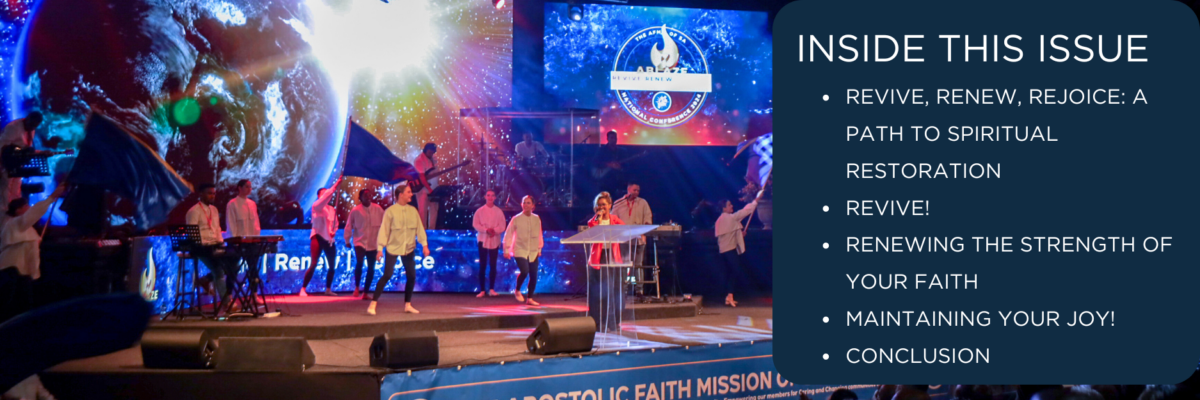
In this edition of our Pastoral Letter, we revisit and capture the essence of the Ablaze Conference theme: Renew, Revive and Rejoice. We asked each National Office Bearer to re-package their Ablaze sermon in a short impactful format. We encourage you to visit our website to access sermon notes and Live Streams:
https://afm-ags.org/ablaze-conference-renew-revive-rejoice/
We trust that these resources will bless you!


1. REVIVE, RENEW, REJOICE: A PATH TO SPIRITUAL RESTORATION
Life can be draining. The constant demands of work, stress, and the state of the world can wear us down, causing us to feel stagnant and distant from God. We might find ourselves simply going through the motions, physically present but mentally and spiritually absent. In these moments, it is essential to recognise the need to reach out to God for revival, renewal, and ultimately, joy. The Israelites experienced a similar state after their return from exile in Babylon. Though they were back in their homeland, much of what they knew was in ruins. In their distress, they sought God’s restoration not only of their physical surroundings but also of their hearts and spirits. As Psalm 85:6 (NIV) cries out, “Will you not revive us again, that your people may rejoice in you?” Their desire for revival was rooted in a longing for God’s presence, leading them to joy.
Psalm 126:1-3 captures the beauty of God's restoration: "When the Lord restored the fortunes of Zion, we were like those who dreamed. Our mouths were filled with laughter, our tongues with songs of joy." When God revives, there is always an outpouring of joy, a return to the vibrant, life-giving presence of the Holy Spirit.
Revive: Awakening Our Spirit
To be revived means to regain life, strength, and consciousness. Revival is a divine work where God reawakens our hearts to His presence and purpose. Through the Holy Spirit, He rekindles our first love for Jesus, igniting the fire of His presence within us. But we must also play a part. Revival begins when we acknowledge our need for God and cry out for His help.
As 2 Chronicles 7:14 (NIV) reminds us, “If my people, who are called by my name, will humble themselves and pray and seek my face and turn from their wicked ways, then I will hear from heaven, and I will forgive their sin and will heal their land.”
Revival calls for humility, seeking God, and turning away from sin. It is not enough to merely go through the motions of faith. We must be real, genuine followers of Jesus who long for His presence. This means regularly engaging in personal and communal prayer, repentance, and seeking God’s face.
“When God revives, there is always an outpouring of joy, a return to the vibrant, life-giving presence of the Holy Spirit.”
Renew: Transforming Our Minds
Renewal is the process of transformation, a marked change in our minds, hearts, and lives. Romans 12:2 (NIV) instructs, “Do not conform to the pattern of this world but be transformed by the renewing of your mind.” Just as a caterpillar transforms into a butterfly, renewal is a continual process that changes us into new creations in Christ. Daily, we must resist the patterns of this world and allow God’s Word and Spirit to work within us.
Ephesians 4:22-24 (NIV) calls us to "put off the old self" and "put on the new self, created to be like God in true righteousness and holiness." This renewal requires us to assess areas of our lives in need of transformation and to embrace our new identity in Christ.
Rejoice: Joy as Our Response
Joy is the natural response to God’s work of revival and renewal. As Paul commands in Philippians 4:4 (NIV), “Rejoice in the Lord always. I will say it again: Rejoice!” Joy is not dependent on our circumstances but is a choice rooted in our faith and trust in God's goodness. Throughout Scripture, we see examples of people like David, who rejoiced in the Lord even in difficult times.
Psalm 51:12 (NIV) expresses his desire: “Restore to me the joy of your salvation and grant me a willing spirit, to sustain me.” Rejoicing in God strengthens our spirit and sustains our faith. It is an expression of gratitude for God's ongoing work in our lives, regardless of what we are going through.
REVIVE!

Memory
The human mind is a complex web of interconnected neurons, forming patterns and pathways that shape our thoughts, beliefs, and actions. These patterns, once established, can be incredibly difficult to break down, especially when they are deeply entrenched through generations of conditioning and societal influence. When your mind is transformed, you acquire the ability to be able to test and approve what God’s will is (Romans 12:1-2).
Our understanding of how things work, and our experiences of life determine how we understand the voice, the will and interpret the plans of God for us (Jeremiah 29:11).
Honour God when He Mightily Works Through You (Judges 15:14-19)
The Lord powerfully used Sampson as read in Judges 15:14. Sampson claimed the glory for the victory when he said “…with a donkey’s jawbone I made donkeys of them”. After Samson claimed the glory of the victory for himself, he carelessly threw away the instrument God used to give the victory (Judges 15:17). Sampson ascribed his victory to his strength and not the Lord who gave him victory. Then he became thirsty and the Lord clave a hollow and miraculously provided water.
We must be careful when we are victorious as we are most vulnerable after being powerfully used by God. We should prepare ourselves for the moment after victory, don’t forget the support that brought you the victory and do not kick away the ladder that others kept for you to climb. Today, when self-praising is rife remember that the glory belongs to the Lord. Humility must be revived. Do not promote yourself to spiritual offices that you have not been ordained to in the AFM. God can continuously renew your mind if you humble yourself.
“Today, when self-praising is rife remember that the glory belongs to the Lord. ”
The Woman with the Issue of Blood
We have all read the story of how the woman who had an issue of blood for twelve years was healed, despite spending all her resources to recover her health, her situation worsened. It is striking that in a later chapter, the story of the healing of a certain woman by Jesus is recalled.
It is evident that from the moment Jesus came face to face with the woman, the crowd was forgotten, and Jesus spoke to that woman as if she was the only person in the world, an unimportant sufferer, with trouble that made her unclean - and yet to that one unimportant person Jesus gave all of himself.
We are very apt to attach labels to people and to treat them according to their relative importance. To Jesus, a person had none of these man-made labels. He or she was simply a human soul in need. Love never thinks of people in terms of human importance.
The Second Fire
This story, then, is about a new morning that has arrived – not only physically but also symbolizing the arrival of a new era. On this new morning, Jesus appeared on the shore, but the disciples did not yet understand the significance of this new morning because they did not recognize that the person on the shore was Jesus. When they arrived on the land, an important sight met them. It was none other than a charcoal fire.
The last time Peter and Jesus were at a fire was in John 18 and the earlier fire brought memories of an uninviting situation of cold, hostile questioning – Peter was braving danger, he was alone, afraid, fearful, humiliated, in pain and his world came crashing down. The first fire is a setting for Peter’s denial and the second for his reinstatement, Jesus uses the second fire with its fish and bread to replace the memory of the first fire - replacing the pain of the first fire with the victory of the second fire, the new commission to feed my sheep.
3. RENEWING THE STRENGTH OF YOUR FAITH
In Hebrew, the word "RENEW" signifies "to change." This concept of transformation is reflected in Scripture, especially in 1 Samuel 10:6 (NASB), which states, “Then the Spirit of the LORD will rush upon you, and you will prophesy with them and be changed into a different man.” This illustrates the significant change that can take place when we encounter God. Isaiah 40:31 reminds us, “They that (patiently) wait upon the Lord shall renew/regain their strength.” This promise is based on the understanding that our God, who “sits above the circle of the earth” (Isaiah 40:22), is never weary or tired. He enables us to triumph over despair through increased faith and strength. We are called to actively participate in this renewal journey, understanding that our strength is derived not from ourselves but from the Lord.
God’s People and Stages of Renewal in Isaiah 40
Isaiah presents a journey from despair to renewal:
Our Despair (40:27): The Israelites experienced despair during captivity, questioning whether God knew their situation. Isaiah addresses their uncertainties, highlighting the conflict between belief and doubt.
God’s Greatness (40:28-29): Isaiah underscores God’s eternal essence, creative power, and limitless strength. This comprehension is vital for overcoming despair.
Our Renewal (40:30-31): The importance of waiting on the Lord is emphasised. Waiting represents an active reliance on God, trusting in His timing and provision.
“We are called to actively participate in this renewal journey, understanding that our strength is derived not from ourselves but from the Lord. ”
The Eagle-Winged Believer
Isaiah’s metaphor of soaring on wings like eagles depicts the transformative nature of faith. Just as God carried Israel “on eagle’s wings” (Exodus 19:4), He provides renewed strength to those who place their trust in Him. “They shall mount up with wings as eagles.” – signifying a continuous rise above life’s challenges. “They shall run and not be weary.” – signifying the energy and progress experienced in faith. “They shall walk and not faint.” – illustrating the perseverance required for daily life, even during trials.


The faith journey can often be exhausting, but God assures us of renewed strength:
Strength Increased: Psalm 84:5, 7 speaks of those whose strength is in the Lord, moving from strength to strength.
Faith Increased: Romans 1:17 highlights living by faith, and even in times of doubt, we can cry out, “Help my unbelief” (Mark 9:23-24).
God’s grace is more than sufficient in our weaknesses. As Paul reflects in 2 Corinthians 12:7-10, it is in our weakness that Christ’s power is made perfect. Let us remember Gideon and his men, who, despite their fatigue, persisted in their pursuit in Judges 8:4. May we soar like eagles, run without fatigue, and walk without fainting. We thank God for the promise of renewal.
4. MAINTAINING YOUR JOY!
Do you remember the joy when you first came to know the Lord? That thrill of everything is new. Why is it that so many Christians lose their joy? Some things will intentionally rob you of your joy. If you don’t know what they are and if you don’t take the proper precautions, you’ll lose your joy.
There are three things in Philippians 3:1-10 on how to maintain your joy while you’re serving the Lord. Phil 3:1 says: “Finally my brothers rejoice in the Lord. It is no trouble for me to write these same things to you again and it is a safeguard for you.” In this passage, he says there are three safeguards for protecting your joy.
We Must Resist Legalistic Attitudes
Legalism is a killjoy. It destroys joy in the Christian life more than anything else I’ve seen. Legalism is substituting rules and rituals for my relationship with Christ. It takes the focus off what God has done for you and slowly puts your focus on what you do for God. In the New Testament, there was a group of people called Judaizers. They said, “Accept Jesus Christ as your Lord and Savior, but you also have to keep these rules.” Paul says “Watch out for those who do evil, those dogs. Men who insist on cutting the body [circumcision]. We worship God by His Spirit and rejoice in our life in Christ. We don’t put any trust in external ceremonies.” Phil. 3:2-3 (Good News Bible). The first safeguard is this: If you want to keep your joy, live each day by grace.
Legalism is putting your trust in Rituals. Phil 3:4 says: “I was circumcised eight days after I was born according to the Jewish law.” Today, a Christian might say, “I was baptized,” or “I joined the church,” or “I took communion.” Paul continues to describe his former life:
Race. Phil 3:5: “Of the people of Israel, I was of the tribe of Benjamin.” - I’ve got a royal pedigree. Religion. Phil 3:5: “I’m a Hebrew of Hebrews.” There are people out there who’d say I am AFM!! Rules. Phil 3:5: “In regard to the law, I was a Pharisee.” The Pharisees were the spiritually elite. Reputation. When you depend upon reputation, you’re getting into legalism. “As for zeal, and as for legalistic righteousness, I was faultless.” There’s nothing wrong with any of these things. The problem is thinking they give you points with God, but He (God) loves you unconditionally. If you start trusting in these things, you’re going to lose your joy. Religion is based upon performance, but Christianity is based on a person, Jesus Christ.
“Religion is based upon performance, but Christianity is based on a person, Jesus Christ. ”
I Must Re-Evaluate My Activities
A lot of people are looking for joy in the wrong places. Phil 7-8 says: “But whatever was to my profit I now consider loss for the sake of Christ. What is more, I consider everything a loss compared to the surpassing greatness of knowing Christ Jesus my Lord for whose sake I have lost all things. I consider them rubbish that I may gain Christ.”
The words “profit” and “loss.” are important. He says whatever was profit I now consider loss. It’s a loss compared to the greatness of knowing Christ for whose sake I’ve lost all things. Keep my priorities in perspective. Don’t lose my joy over things that aren’t important.
I Have to Refocus My Ambitions
Lasting joy comes from knowing Christ better and better. Phil 3:10 says: “I want to know Christ and the power of His resurrection and the fellowship of sharing in His suffering becoming like Him in His death.” Do you know Jesus Christ? Your life will have no impact if you don’t know Christ - not know about Him - more than that: Know Him! My question to you remains standing:
Are you still a JOYFUL Christian?
Conclusion

A Call to Action
As followers of Christ, we are called to continuously pursue revival, seek renewal, and choose to rejoice in the Lord daily. Let this be a challenge for all of us to live out these principles in our personal and communal faith journeys. As we humble ourselves, seek God's face, and embrace transformation, we will experience the joy of the Lord, which strengthens and sustains us.
Let us pray for revival in our hearts, renewal of our minds, and an outpouring of joy as we walk with the Lord. May we live revived, renewed, and rejoicing in His presence.
Friendly Regards
Dr Henri Weideman